
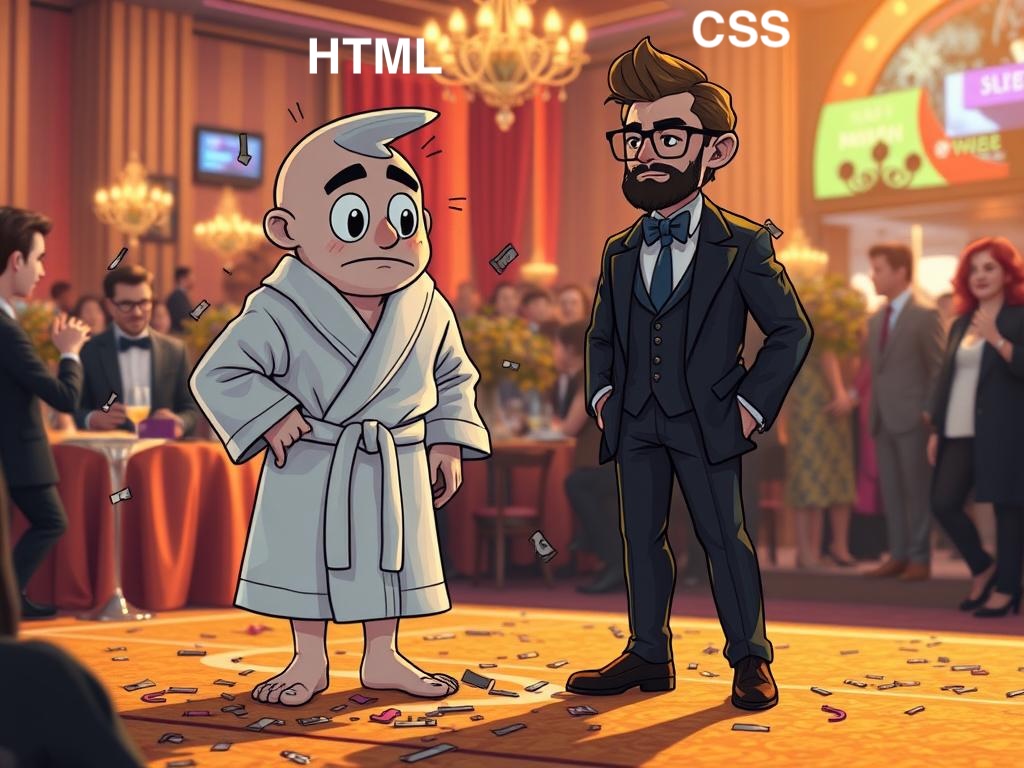
Picture this: the early internet. A glorious, chaotic, pixelated mess. HTML, bless its foundational heart, was the main game in town. It was fantastic at structuring content… “Here’s a heading! Here’s a paragraph! Here’s an image!”, but it had a severe identity crisis when it came to looking good.
HTML was like that friend who shows up to a black-tie gala in a bathrobe, loudly declaring, “But it’s comfortable!” Developers, desperate to make their pages visually appealing, began stretching HTML to its absolute breaking point. They’d nest <font> tags with reckless abandon, sprinkle inline styles directly onto every element, and even resort to image-based layouts.
It was a nightmare. It was a perpetual wrestling match between content and presentation. Every single heading, every paragraph, every link had to be individually told: “You are blue! You are bold! You are size 12!” Change your mind about the color blue? Great, now go update 500 individual lines across 50 pages. It was like trying to style an entire marching band by pinning ribbons onto each individual musician, one by one, while they were performing.
The web was screaming for a stylist.
The Problem: HTML’s Identity Crisis
HTML’s original job was simple: mark up content. It was designed to say, “This is important” (<h1>), “This is text” (<p>), “This is a link” (<a>). It was not designed to say, “And this particular piece of text should be crimson, Arial, 14px, italic, centered, and have a shimmering aura of unicorn glitter.”
But designers wanted unicorn glitter auras. And so, HTML was forced into a role it wasn’t meant for. It became bloated, inefficient, and virtually unmanageable. The code was a tangled spaghetti monster of structural tags mixed with presentation instructions.
Enter the Heroes: Håkon Wium Lie and Bert Bos


The Visionaries Behind the Web’s Makeover: Håkon Wium Lie (left) and Bert Bos (right)
Our story’s intrepid heroes weren’t wielding swords or magic. They were wielding specifications and a dream of separation.
In 1994, Håkon Wium Lie, a brilliant Norwegian computer scientist working at CERN in Switzerland (yes, the very place where the World Wide Web was born!), proposed Cascading HTML Style Sheets (CHSS). His vision was elegant: let HTML do its job (structure), and let something else handle the styling. This “something else” would live in a separate layer, so designers could control the look of an entire site from a single, central place instead of decorating every tag by hand.
He wasn’t alone in this pursuit of order. Bert Bos joined forces with Lie, and together they refined the concept, dropped the “H” (for HTML) from CHSS, and shaped what we now know as Cascading Style Sheets (CSS).
Their proposal wasn’t embraced overnight. The web, still shuffling around in its bathrobe of <font> tags and layout tables, was resistant to change. There were debates, counter-proposals, and the usual standards-process squabbles. But the need was so painfully obvious that, eventually, everyone had to admit it: sooner or later, the web would have to discover style.
The Revolution: From Chaos to Cascade
In 1996, CSS Level 1 became a W3C Recommendation. It was modest, but revolutionary. It let us define styles once – in a separate stylesheet or a <style> block in the <head> -instead of repeating the same presentation instructions on every single tag.
Suddenly:
- HTML breathed a sigh of relief: “Finally! I can just be myself! A structural markup language!”
- Designers cheered: “We can change the font of every heading on every page with one line of code!”
- The web started looking like it meant it: Websites could now be visually consistent, aesthetically pleasing, and much, much easier to maintain.
It was the dawn of organized web design. The “cascading” part was genius – it meant you could have multiple stylesheets (browser defaults, user preferences, author styles) that would “cascade” down, applying rules in a specific order, resolving conflicts, and giving incredible flexibility.
The Web’s Permanent Glow-Up
CSS didn’t just clean up HTML’s act; it empowered an entire generation of web designers. As it evolved, it made responsive design, smooth animations, complex layouts, and real visual sophistication possible in a way that would’ve been unthinkable in the pre-CSS chaos.
Without CSS, the internet would still be a clunky, visually inconsistent place, perpetually stuck in its early-90s fashion disaster. CSS pulled HTML out of self-styling purgatory, gave web pages a proper wardrobe, and helped transform the digital realm from a wild mess of content into the kind of beautifully designed, interactive experiences we move through every day.
So the next time you marvel at a slick website, appreciate that elegant typography, or enjoy a perfectly aligned layout, give a quiet nod to CSS. It’s the web’s resident stylist; it is the layer that taught the internet how to get dressed, and in doing so, became a huge part of what we now think of as modern web design.


Leave a Reply